

Welcome to our free mg to ml calculator, designed to make complex fluid conversions effortless.
Whether you need to determine a liquid medicine dosage or convert a recipe ingredient, switching from a solid measurement (mass) to a liquid one (volume) requires knowing the specific substance density.
Because a milligram measures weight and a milliliter measures space, you cannot simply swap the numbers; our tool does the heavy lifting for you.
Instead of stressing over manual formulas, use this tool to instantly convert milligrams to milliliters. It bridges the gap between mass to volume, ensuring your math is perfectly precise every single time.
Try the calculator below to handle your milligrams to milliliters conversion in seconds.
How to Convert Milligrams to Milliliters
If you have ever looked at a medicine bottle or a recipe and felt confused about milligram to milliliter conversion, you are not alone.
This guide breaks down the process in plain words, so you can use an mg to ml calculator correctly and understand what is happening behind the numbers.
What Is the Difference Between MG and ML?
A milligram (mg) measures weight or mass. A milliliter (ml) measures volume, or how much space a liquid takes up.
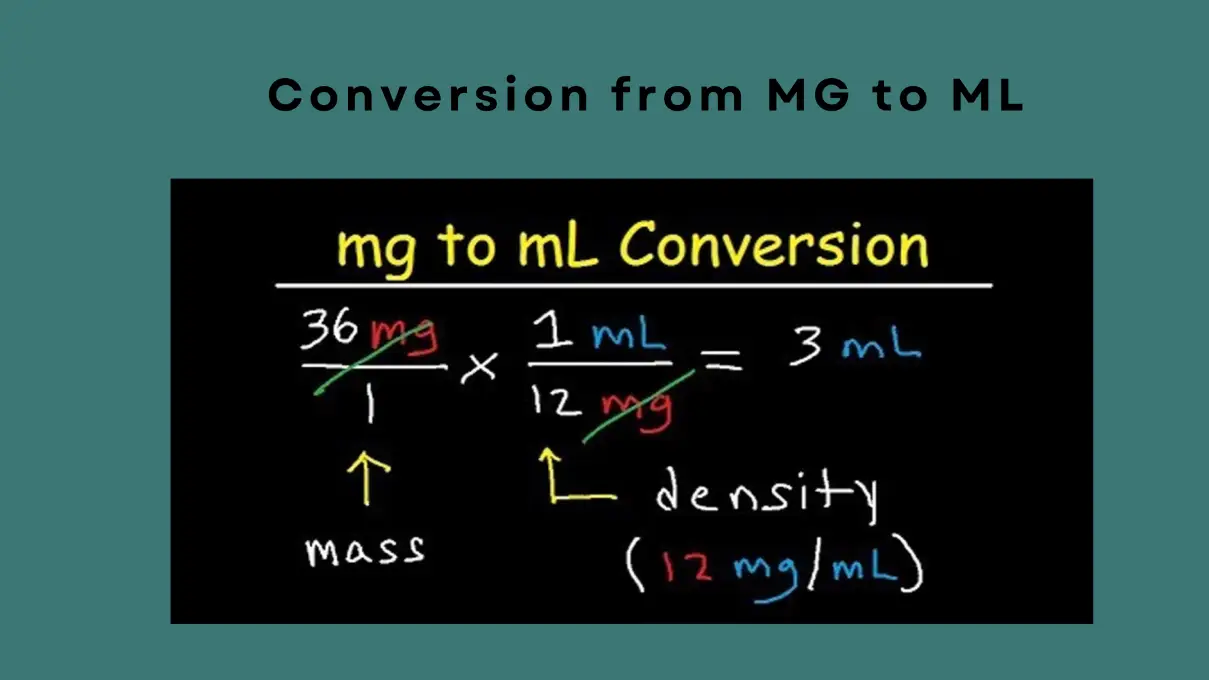
This is the main reason people get confused. You cannot convert mg to ml directly unless you know one more detail: the density or concentration of the substance.
Think of it like this: a spoon of honey weighs more than a spoon of water, even though both fill the same volume. That is because each liquid has its own mass-to-volume ratio. This ratio is what makes unit conversion possible.
The MG to ML Conversion Formula
The standard conversion formula used by any mg to ml calculator is:
ML = MG ÷ Density (or Concentration in mg/ml)
For example, if a liquid has a concentration of 5 mg per ml, and you have 50 mg, the formula looks like this:
50 ÷ 5 = 10 ml
This same dosage calculation method applies whether you are working with liquid medication, cooking ingredients, or lab solutions.
The key is always finding the correct density value or concentration label for the exact substance you are measuring, since this number changes from product to product.
MG to ML for Water (A Simple Reference Point)
Water is the easiest substance to convert because its density is almost exactly 1 gram per milliliter, which equals 1000 mg per ml. So:
- 1000 mg of water = 1 ml
- 500 mg of water = 0.5 ml
- 5000 mg of water = 5 ml
This is why many people use water as a reference point when learning mass to volume conversion.
However, this 1:1 pattern only works for water. Other liquids, like oils, syrups, or medical solutions, have different densities, so the same shortcut cannot be used for them.
Common MG to ML Conversion Chart
Below is a general conversion chart based on common concentration levels found in liquid dosage forms. Always check the actual label, since real products vary.
| Concentration | 50 mg equals | 100 mg equals |
|---|---|---|
| 1 mg/ml | 50 ml | 100 ml |
| 5 mg/ml | 10 ml | 20 ml |
| 10 mg/ml | 5 ml | 10 ml |
| 25 mg/ml | 2 ml | 4 ml |
This kind of quick reference table helps you estimate values fast, but a precise calculator is always safer for anything related to medicine dosage or health measurements.
Why an MG to ML Calculator Is Useful
A digital mg to ml calculator removes the guesswork from manual conversion. Instead of doing the math by hand, you simply enter the milligram amount and the concentration, and the tool gives you the milliliter result instantly. This is especially helpful for:
- Parents measuring children’s medicine
- Nurses and caregivers handling liquid prescriptions
- Home cooks converting recipe measurements
- Lab technicians preparing chemical solutions
Using a calculator also reduces human error, which matters most when the substance involves medication dosing.
A small mistake in unit conversion can lead to giving too much or too little of a product, so accuracy is not optional when health is involved.
Tips for Accurate MG to ML Conversions
To get a reliable conversion result, keep these points in mind:
- Always confirm the density or concentration of the exact product, not a general average.
- Use a calibrated measuring tool, like an oral syringe, instead of a regular kitchen spoon.
- Double-check the label instructions on medicine bottles, since concentration can differ between brands.
- When in doubt about medical dosage, ask a pharmacist or doctor instead of relying only on a calculator.
Following these simple habits keeps your liquid measurement accurate and safe, whether you are working in a kitchen, a lab, or a home medicine cabinet.
Frequently Asked Questions
1. Can I convert mg to ml without knowing the density?
No. Since mg measures weight and ml measures volume, you need the density or concentration value to get an accurate conversion.
2. Is 1 mg equal to 1 ml?
Only for substances with a density of exactly 1, such as water at room temperature. Most other liquids do not follow this pattern.
3. How do I convert mg to ml for liquid medicine?
Check the concentration printed on the bottle, usually shown as mg/ml, then divide the total milligram dose by that number.
4. Why do mg and ml conversions differ between products?
Because every liquid has a different density, based on its ingredients. A syrup and water will never convert the same way.
5. Is it safe to estimate mg to ml conversions for medicine?
It is best to avoid estimating. Use an accurate mg to ml calculator or ask a healthcare professional, especially for children’s dosage or prescription drugs.
